 Add to Chrome
 Add to Firefox
 Add to Edge
MAC: A Conversion Rate Prediction Benchmark Featuring Labels Under Multiple Attribution Mechanisms
Mar 02, 2026
Multi-attribution learning (MAL), which enhances model performance by learning from conversion labels yielded by multiple attribution mechanisms, has emerged as a promising learning paradigm for conversion rate (CVR) prediction. However, the conversion labels in public CVR datasets are generated by a single attribution mechanism, hindering the development of MAL approaches. To address this data gap, we establish the Multi-Attribution Benchmark (MAC), the first public CVR dataset featuring labels from multiple attribution mechanisms. Besides, to promote reproducible research on MAL, we develop PyMAL, an open-source library covering a wide array of baseline methods. We conduct comprehensive experimental analyses on MAC and reveal three key insights: (1) MAL brings consistent performance gains across different attribution settings, especially for users featuring long conversion paths. (2) The performance growth scales up with objective complexity in most settings; however, when predicting first-click conversion targets, simply adding auxiliary objectives is counterproductive, underscoring the necessity of careful selection of auxiliary objectives. (3) Two architectural design principles are paramount: first, to fully learn the multi-attribution knowledge, and second, to fully leverage this knowledge to serve the main task. Motivated by these findings, we propose Mixture of Asymmetric Experts (MoAE), an effective MAL approach incorporating multi-attribution knowledge learning and main task-centric knowledge utilization. Experiments on MAC show that MoAE substantially surpasses the existing state-of-the-art MAL method. We believe that our benchmark and insights will foster future research in the MAL field. Our MAC benchmark and the PyMAL algorithm library are publicly available at https://github.com/alimama-tech/PyMAL.

EST: Towards Efficient Scaling Laws in Click-Through Rate Prediction via Unified Modeling
Feb 11, 2026Efficiently scaling industrial Click-Through Rate (CTR) prediction has recently attracted significant research attention. Existing approaches typically employ early aggregation of user behaviors to maintain efficiency. However, such non-unified or partially unified modeling creates an information bottleneck by discarding fine-grained, token-level signals essential for unlocking scaling gains. In this work, we revisit the fundamental distinctions between CTR prediction and Large Language Models (LLMs), identifying two critical properties: the asymmetry in information density between behavioral and non-behavioral features, and the modality-specific priors of content-rich signals. Accordingly, we propose the Efficiently Scalable Transformer (EST), which achieves fully unified modeling by processing all raw inputs in a single sequence without lossy aggregation. EST integrates two modules: Lightweight Cross-Attention (LCA), which prunes redundant self-interactions to focus on high-impact cross-feature dependencies, and Content Sparse Attention (CSA), which utilizes content similarity to dynamically select high-signal behaviors. Extensive experiments show that EST exhibits a stable and efficient power-law scaling relationship, enabling predictable performance gains with model scale. Deployed on Taobao's display advertising platform, EST significantly outperforms production baselines, delivering a 3.27\% RPM (Revenue Per Mile) increase and a 1.22\% CTR lift, establishing a practical pathway for scalable industrial CTR prediction models.
Modeling Cascaded Delay Feedback for Online Net Conversion Rate Prediction: Benchmark, Insights and Solutions
Jan 29, 2026In industrial recommender systems, conversion rate (CVR) is widely used for traffic allocation, but it fails to fully reflect recommendation effectiveness because it ignores refund behavior. To better capture true user satisfaction and business value, net conversion rate (NetCVR), defined as the probability that a clicked item is purchased and not refunded, has been proposed.Unlike CVR, NetCVR prediction involves a more complex multi-stage cascaded delayed feedback process. The two cascaded delays from click to conversion and from conversion to refund have opposite effects, making traditional CVR modeling methods inapplicable. Moreover, the lack of open-source datasets and online continuous training schemes further hinders progress in this area.To address these challenges, we introduce CASCADE (Cascaded Sequences of Conversion and Delayed Refund), the first large-scale open dataset derived from the Taobao app for online continuous NetCVR prediction. Through an in-depth analysis of CASCADE, we identify three key insights: (1) NetCVR exhibits strong temporal dynamics, necessitating online continuous modeling; (2) cascaded modeling of CVR and refund rate outperforms direct NetCVR modeling; and (3) delay time, which correlates with both CVR and refund rate, is an important feature for NetCVR prediction.Based on these insights, we propose TESLA, a continuous NetCVR modeling framework featuring a CVR-refund-rate cascaded architecture, stage-wise debiasing, and a delay-time-aware ranking loss. Extensive experiments demonstrate that TESLA consistently outperforms state-of-the-art methods on CASCADE, achieving absolute improvements of 12.41 percent in RI-AUC and 14.94 percent in RI-PRAUC on NetCVR prediction. The code and dataset are publicly available at https://github.com/alimama-tech/NetCVR.
Delayed Feedback Modeling for Post-Click Gross Merchandise Volume Prediction: Benchmark, Insights and Approaches
Jan 28, 2026The prediction objectives of online advertisement ranking models are evolving from probabilistic metrics like conversion rate (CVR) to numerical business metrics like post-click gross merchandise volume (GMV). Unlike the well-studied delayed feedback problem in CVR prediction, delayed feedback modeling for GMV prediction remains unexplored and poses greater challenges, as GMV is a continuous target, and a single click can lead to multiple purchases that cumulatively form the label. To bridge the research gap, we establish TRACE, a GMV prediction benchmark containing complete transaction sequences rising from each user click, which supports delayed feedback modeling in an online streaming manner. Our analysis and exploratory experiments on TRACE reveal two key insights: (1) the rapid evolution of the GMV label distribution necessitates modeling delayed feedback under online streaming training; (2) the label distribution of repurchase samples substantially differs from that of single-purchase samples, highlighting the need for separate modeling. Motivated by these findings, we propose RepurchasE-Aware Dual-branch prEdictoR (READER), a novel GMV modeling paradigm that selectively activates expert parameters according to repurchase predictions produced by a router. Moreover, READER dynamically calibrates the regression target to mitigate under-estimation caused by incomplete labels. Experimental results show that READER yields superior performance on TRACE over baselines, achieving a 2.19% improvement in terms of accuracy. We believe that our study will open up a new avenue for studying online delayed feedback modeling for GMV prediction, and our TRACE benchmark with the gathered insights will facilitate future research and application in this promising direction. Our code and dataset are available at https://github.com/alimama-tech/OnlineGMV .
Multi-Behavior Sequential Modeling with Transition-Aware Graph Attention Network for E-Commerce Recommendation
Jan 21, 2026User interactions on e-commerce platforms are inherently diverse, involving behaviors such as clicking, favoriting, adding to cart, and purchasing. The transitions between these behaviors offer valuable insights into user-item interactions, serving as a key signal for un- derstanding evolving preferences. Consequently, there is growing interest in leveraging multi-behavior data to better capture user intent. Recent studies have explored sequential modeling of multi- behavior data, many relying on transformer-based architectures with polynomial time complexity. While effective, these approaches often incur high computational costs, limiting their applicability in large-scale industrial systems with long user sequences. To address this challenge, we propose the Transition-Aware Graph Attention Network (TGA), a linear-complexity approach for modeling multi-behavior transitions. Unlike traditional trans- formers that treat all behavior pairs equally, TGA constructs a structured sparse graph by identifying informative transitions from three perspectives: (a) item-level transitions, (b) category-level transitions, and (c) neighbor-level transitions. Built upon the structured graph, TGA employs a transition-aware graph Attention mechanism that jointly models user-item interactions and behav- ior transition types, enabling more accurate capture of sequential patterns while maintaining computational efficiency. Experiments show that TGA outperforms all state-of-the-art models while sig- nificantly reducing computational cost. Notably, TGA has been deployed in a large-scale industrial production environment, where it leads to impressive improvements in key business metrics.
MUSE: A Simple Yet Effective Multimodal Search-Based Framework for Lifelong User Interest Modeling
Dec 08, 2025Lifelong user interest modeling is crucial for industrial recommender systems, yet existing approaches rely predominantly on ID-based features, suffering from poor generalization on long-tail items and limited semantic expressiveness. While recent work explores multimodal representations for behavior retrieval in the General Search Unit (GSU), they often neglect multimodal integration in the fine-grained modeling stage -- the Exact Search Unit (ESU). In this work, we present a systematic analysis of how to effectively leverage multimodal signals across both stages of the two-stage lifelong modeling framework. Our key insight is that simplicity suffices in the GSU: lightweight cosine similarity with high-quality multimodal embeddings outperforms complex retrieval mechanisms. In contrast, the ESU demands richer multimodal sequence modeling and effective ID-multimodal fusion to unlock its full potential. Guided by these principles, we propose MUSE, a simple yet effective multimodal search-based framework. MUSE has been deployed in Taobao display advertising system, enabling 100K-length user behavior sequence modeling and delivering significant gains in top-line metrics with negligible online latency overhead. To foster community research, we share industrial deployment practices and open-source the first large-scale dataset featuring ultra-long behavior sequences paired with high-quality multimodal embeddings. Our code and data is available at https://taobao-mm.github.io.
See Beyond a Single View: Multi-Attribution Learning Leads to Better Conversion Rate Prediction
Aug 21, 2025Conversion rate (CVR) prediction is a core component of online advertising systems, where the attribution mechanisms-rules for allocating conversion credit across user touchpoints-fundamentally determine label generation and model optimization. While many industrial platforms support diverse attribution mechanisms (e.g., First-Click, Last-Click, Linear, and Data-Driven Multi-Touch Attribution), conventional approaches restrict model training to labels from a single production-critical attribution mechanism, discarding complementary signals in alternative attribution perspectives. To address this limitation, we propose a novel Multi-Attribution Learning (MAL) framework for CVR prediction that integrates signals from multiple attribution perspectives to better capture the underlying patterns driving user conversions. Specifically, MAL is a joint learning framework consisting of two core components: the Attribution Knowledge Aggregator (AKA) and the Primary Target Predictor (PTP). AKA is implemented as a multi-task learner that integrates knowledge extracted from diverse attribution labels. PTP, in contrast, focuses on the task of generating well-calibrated conversion probabilities that align with the system-optimized attribution metric (e.g., CVR under the Last-Click attribution), ensuring direct compatibility with industrial deployment requirements. Additionally, we propose CAT, a novel training strategy that leverages the Cartesian product of all attribution label combinations to generate enriched supervision signals. This design substantially enhances the performance of the attribution knowledge aggregator. Empirical evaluations demonstrate the superiority of MAL over single-attribution learning baselines, achieving +0.51% GAUC improvement on offline metrics. Online experiments demonstrate that MAL achieved a +2.6% increase in ROI (Return on Investment).
Stick to Facts: Towards Fidelity-oriented Product Description Generation
Mar 12, 2025Different from other text generation tasks, in product description generation, it is of vital importance to generate faithful descriptions that stick to the product attribute information. However, little attention has been paid to this problem. To bridge this gap, we propose a model named Fidelity-oriented Product Description Generator (FPDG). FPDG takes the entity label of each word into account, since the product attribute information is always conveyed by entity words. Specifically, we first propose a Recurrent Neural Network (RNN) decoder based on the Entity-label-guided Long Short-Term Memory (ELSTM) cell, taking both the embedding and the entity label of each word as input. Second, we establish a keyword memory that stores the entity labels as keys and keywords as values, allowing FPDG to attend to keywords by attending to their entity labels. Experiments conducted on a large-scale real-world product description dataset show that our model achieves state-of-the-art performance in terms of both traditional generation metrics and human evaluations. Specifically, FPDG increases the fidelity of the generated descriptions by 25%.
Enhancing Taobao Display Advertising with Multimodal Representations: Challenges, Approaches and Insights
Jul 28, 2024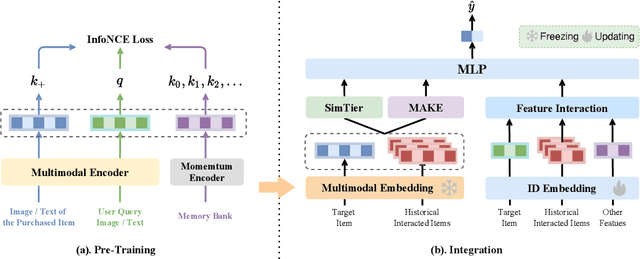
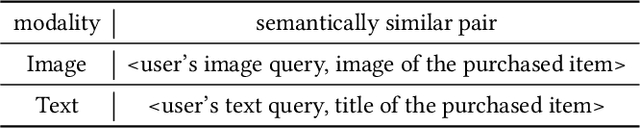
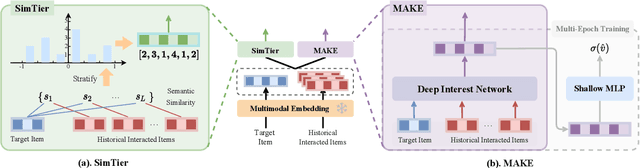

Despite the recognized potential of multimodal data to improve model accuracy, many large-scale industrial recommendation systems, including Taobao display advertising system, predominantly depend on sparse ID features in their models. In this work, we explore approaches to leverage multimodal data to enhance the recommendation accuracy. We start from identifying the key challenges in adopting multimodal data in a manner that is both effective and cost-efficient for industrial systems. To address these challenges, we introduce a two-phase framework, including: 1) the pre-training of multimodal representations to capture semantic similarity, and 2) the integration of these representations with existing ID-based models. Furthermore, we detail the architecture of our production system, which is designed to facilitate the deployment of multimodal representations. Since the integration of multimodal representations in mid-2023, we have observed significant performance improvements in Taobao display advertising system. We believe that the insights we have gathered will serve as a valuable resource for practitioners seeking to leverage multimodal data in their systems.
Capturing Conversion Rate Fluctuation during Sales Promotions: A Novel Historical Data Reuse Approach
May 22, 2023
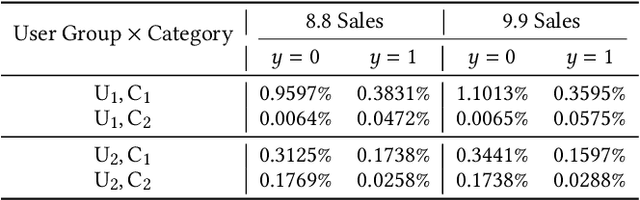
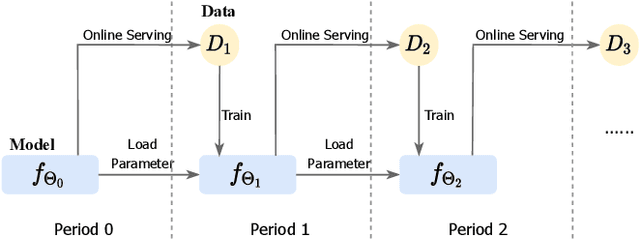
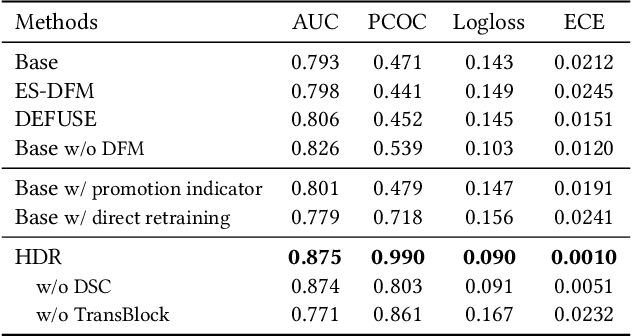
Conversion rate (CVR) prediction is one of the core components in online recommender systems, and various approaches have been proposed to obtain accurate and well-calibrated CVR estimation. However, we observe that a well-trained CVR prediction model often performs sub-optimally during sales promotions. This can be largely ascribed to the problem of the data distribution shift, in which the conventional methods no longer work. To this end, we seek to develop alternative modeling techniques for CVR prediction. Observing similar purchase patterns across different promotions, we propose reusing the historical promotion data to capture the promotional conversion patterns. Herein, we propose a novel \textbf{H}istorical \textbf{D}ata \textbf{R}euse (\textbf{HDR}) approach that first retrieves historically similar promotion data and then fine-tunes the CVR prediction model with the acquired data for better adaptation to the promotion mode. HDR consists of three components: an automated data retrieval module that seeks similar data from historical promotions, a distribution shift correction module that re-weights the retrieved data for better aligning with the target promotion, and a TransBlock module that quickly fine-tunes the original model for better adaptation to the promotion mode. Experiments conducted with real-world data demonstrate the effectiveness of HDR, as it improves both ranking and calibration metrics to a large extent. HDR has also been deployed on the display advertising system in Alibaba, bringing a lift of $9\%$ RPM and $16\%$ CVR during Double 11 Sales in 2022.